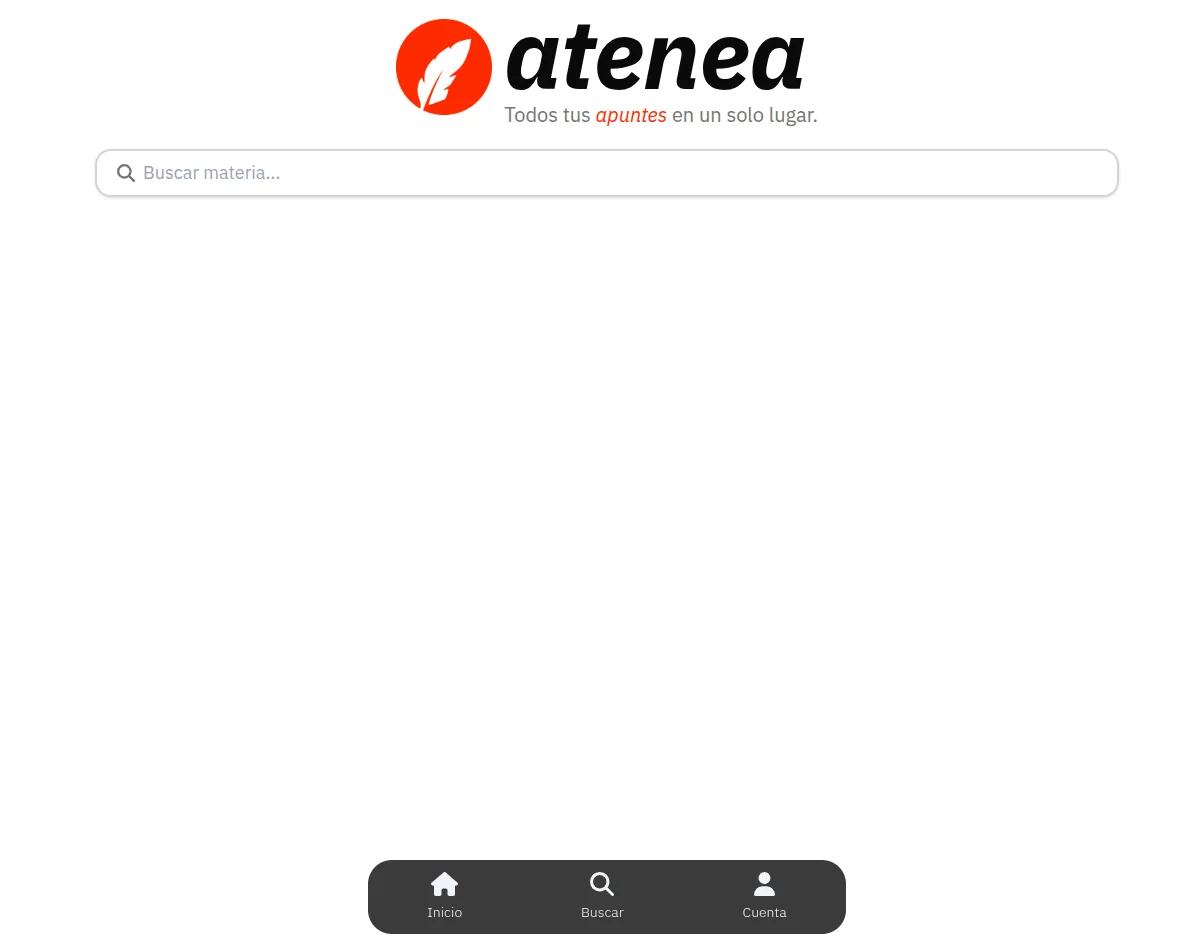
Atenea
A system to centralize every students' university notes, organized by subject and with a reputation system
Links
Origin
We realized pretty early on that students don’t just rely on what they write in class. Notes come from everywhere: the institutional Drive, random shared folders, WhatsApp groups, PDFs someone sent three semesters ago, screenshots, photos of whiteboards… you name it. The real problem isn’t the lack of notes — it’s knowing where each one is when you actually need it. Finding that one crucial explanation five minutes before an exam can feel like digital archaeology.
That’s where Atenea comes in.
Atenea is a system designed to keep all your notes in one single place. A place where everything can be tagged, categorized, and organized in a way that actually makes sense. No more guessing whether that explanation was in a PDF, a Google Doc, or “that file Juan shared once”. Atenea is focused specifically on our university, taking into account how subjects, courses, and study plans are structured here.
Now, here’s where things get… interesting.
Maybe — just maybe — we got access to some internal APIs and scraped all the study plans from every degree offered by the faculty. That way, we magically ended up with every subject neatly mapped, complete with its official code. For example: Operating Systems – 72.11, straight out of Computer Engineering. Hypothetically speaking, of course. It would have been smarter to automate all that. But obviously, we did it by hand.
In Atenea, you can upload notes in multiple formats: plain text using Markdown for fast and clean writing, or PDFs when things get heavy with diagrams, equations, or scanned material. On top of that, notes can be heavily tagged and categorized — whether it’s a general summary, a specific exercise from a practice sheet, a theoretical explanation, or that one trick that always shows up in exams.
Under the hood, Atenea is built with Python, Django, and PostgreSQL for a very simple reason: at the time, we already knew Python and wanted to actually build something real while learning Django properly. Instead of tutorials and toy examples, we chose to learn by doing — and Atenea was the excuse to turn what we already knew into a working product.
The idea is to take Atenea into real-world use and let people use it freely. Long-term, the platform is meant to be sustained by community support and donations from the people who find it useful and want to keep it alive.
Roadmap
- Centralize all notes in a single platform with tagging, categorization, and subject-based organization.
- Implement the concept of multiple possible solutions for a given exercise, with community voting similar to Reddit or Stack Overflow (yes, the classic upvote/downvote arrows).
- Allow users to add hints to exercises, helping others progress without revealing the full solution immediately.
- Introduce verified notes and verified solutions, endorsed by professors or teaching assistants, to ensure accuracy and trust.
- Build a wiki-style navigation system, with links between related notes — almost like a Wikipedia for your subjects — or even an “ORM for notes” to connect concepts and improve searchability.
- Create a notes marketplace, where students can share, exchange, or even sell their best and most polished notes.